You checked your CIBIL score. It's lower than you expected. Now what?
Here's what actually moves the needle — and what's a waste of time.
What a CIBIL score actually is, and why it matters
Your CIBIL score runs from 300 to 900. Higher is better, and the bands matter more than the exact number:
- Below 650 — most banks will reject you outright, or approve you at noticeably higher interest rates.
- 650–749 — you'll generally get approved, but not at the best rates on offer.
- 750+ — considered good. Most banks approve at standard rates from here.
- 800+ — you're in the best-deals zone: lowest rates, highest limits, fastest approvals.
It's not just about home loans. Your score affects personal loan eligibility, credit card approvals and limits, and — increasingly — some employers run a credit check as part of background verification for finance-adjacent roles.
The practical reason to care: a 100-point difference in your score can mean a meaningfully different interest rate on the same loan amount. See how much that actually costs over the loan tenure on the EMI calculator →
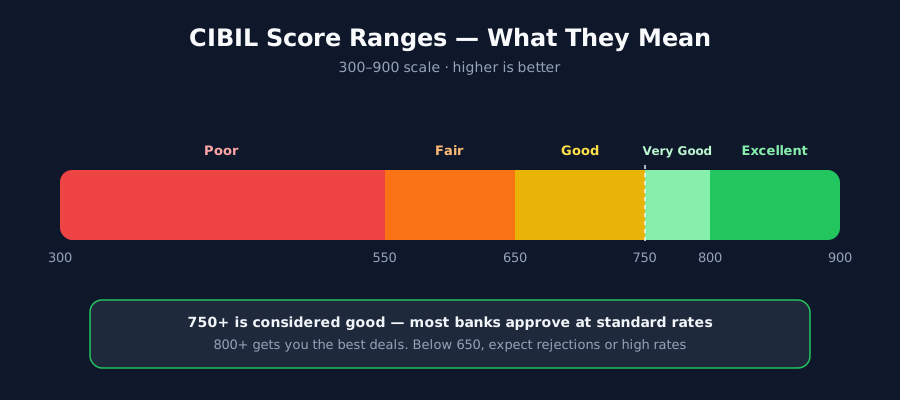
The jump from "Good" to "Very Good" at 750 is the one that matters most — it's where most banks switch to standard approval.
What actually affects your score (and by how much)
CIBIL doesn't publish an exact formula, but the approximate weightage is well understood from how the score behaves:
- Payment history (~35%) — the single biggest factor. One missed EMI or credit card payment hurts significantly, more than almost anything else on this list.
- Credit utilization (~30%) — how much of your available credit limit you're actually using. Keep it below 30%, ideally below 10%, for the best impact.
- Length of credit history (~15%) — older accounts help your score. This is the main reason not to close your oldest credit card, even one you barely use.
- Credit mix (~10%) — having both secured debt (home loan, car loan) and unsecured debt (credit card) helps slightly. Not essential, but it counts.
- New credit inquiries (~10%) — every hard inquiry (an actual loan or card application) drops your score temporarily. Applying for multiple loans or cards in a short window compounds this.
What actually moves the score — specific actions
Never miss a payment. Set auto-pay for at least the minimum due on every credit card and EMI. Missing even one payment can drop your score by 50–100 points, and it stays on your report for years.
Reduce credit utilization immediately. If you're using ₹80,000 of a ₹1,00,000 limit, that's 80% utilization — high enough to hurt you even if you pay in full every month. Pay down the balance, or ask your bank for a limit increase (a soft-pull limit increase doesn't usually trigger a hard inquiry — confirm with your bank first).
Don't close old credit cards. Keep them active with an occasional small transaction, even if you've moved on to a better card. Closing them shortens your average credit history and can raise your utilization ratio on the cards that remain.
Become an authorized add-on user on a family member's old, well-managed card. Their payment history and account age can reflect positively on your own report.
Check your CIBIL report for errors. Wrong accounts that aren't yours, incorrect payment history, loans you've already closed still showing as active — these happen more often than people expect. Dispute them directly on the CIBIL website; don't just leave them.
How long it actually takes — an honest timeline
There's no fast track here. Realistic timeframes:
- Fixing a reporting error: 30–45 days after you file a dispute.
- Reducing utilization: 1–2 billing cycles for the lower number to reflect in your score.
- Recovering from a missed payment: 6–12 months of consistent on-time payments afterward.
- Building credit from scratch (no history): 6–12 months, typically starting with a secured credit card or a credit builder loan.
- Going from 650 to 750+: typically 12–18 months of consistent good behavior. No shortcuts, no hacks — just time and discipline.
750 is the finish line — you don't need 900
Once you're above 750, you've essentially won the CIBIL game for practical purposes. The difference between a 760 and an 820 is almost meaningless for most loan products — both get you the same standard rate at most banks.
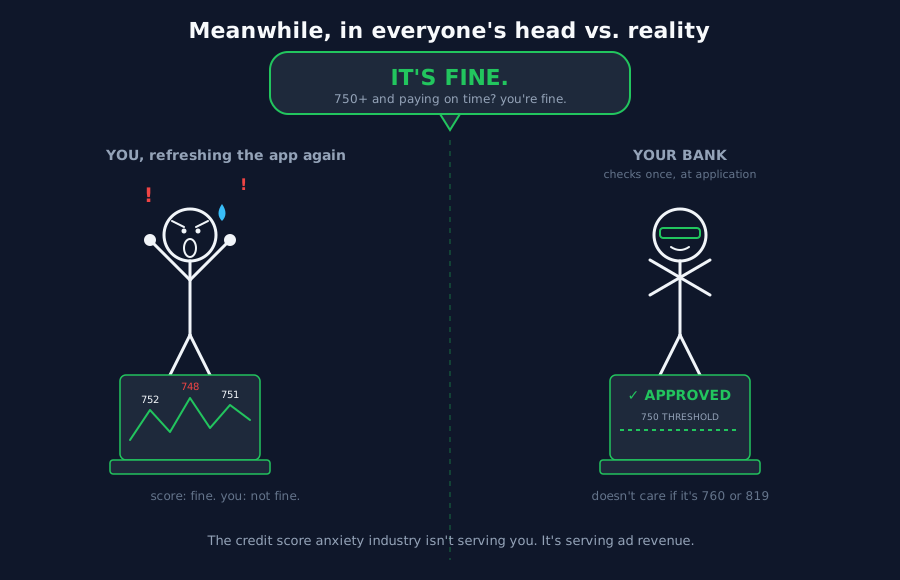
Banks care about whether you're above or below their threshold, not the exact number. Most set that threshold at 750. And your score will naturally fluctuate by 5–20 points month to month for completely normal reasons — a new statement balance, a fresh credit inquiry, a reporting timing difference between your bank and the bureau. That's normal, not a crisis.
The only number that actually matters: are you above 750, and are you paying on time? Yes to both? Stop checking your score every week.
The credit score anxiety industry — apps that ping you every time your score moves a point, YouTube channels dedicated to the thrilling journey from 811 to 819 — is not serving you. They're serving their ad revenue.
The myths — what doesn't actually work
"Closing bad accounts improves your score." Wrong. Closed accounts stay on your credit report for years regardless, and closing a card can actually increase your utilization ratio on what's left.
"Checking your own CIBIL score hurts it." Wrong. Self-checks are soft inquiries — they don't affect your score at all. Check as often as you want.
"Settling a loan improves your score." Wrong, and this one matters: a "settled" status on your report is worse than "closed." It signals to future lenders that you didn't pay the full amount owed. Always pay in full if you can possibly manage it.
"Credit repair companies can fix your score fast." Mostly scams. Anything a credit repair company does — disputing errors, negotiating with lenders — you can do yourself, for free, directly with CIBIL or your bank.
"Having no credit card means a good score." Wrong. No credit history usually means no score at all, or a weak one — lenders have nothing to evaluate you on, which is its own problem.
If your score is very low (below 600) — what to do
Start with a secured credit card, issued against a fixed deposit. It's the single easiest way to start building a credit history when your score is too low for an unsecured card. Not sure how much you can set aside for the FD? Check your in-hand salary first →
Use the card for small, routine purchases — groceries, fuel — and pay the full balance every month, not just the minimum due.
Don't apply for unsecured personal loans in the meantime. At a low score, you'll likely get rejected, and that rejection itself generates a hard inquiry that drags your score down further.
Be patient. There is no fast track from 580 to 750. It's built one on-time payment at a time.
How to check your score for free
- CIBIL's own website gives you one free full report per year.
- Paisabazaar, BankBazaar, CRED, and similar platforms offer free score checks any time — these are soft inquiries and don't affect your score.
- Check at least once a year, even if you're not planning to apply for anything. Catching an error or a fraudulent account early is a lot easier than disputing it after it's already cost you a rejection.
Quick FAQ
Q: How often does CIBIL score update? A: Monthly — your score updates once a month based on what lenders report to CIBIL.
Q: Does salary affect CIBIL score? A: No. CIBIL only tracks credit behavior, not income. Someone earning less with a clean repayment history will score higher than a high earner who misses payments.
Q: I've never taken a loan or credit card — what's my score? A: Likely -1 or NH (No History) — not bad, just blank. Get a secured credit card to start building history.
Q: Will paying off my entire credit card balance boost my score? A: Yes. If you were carrying a high balance, paying it off reduces your utilization ratio and typically shows up as a score improvement within 1–2 billing cycles.
This is general guidance, not personalized financial or credit advice. CIBIL scoring details and weightages are approximate and can vary by bureau and over time — treat the percentages here as directional, not exact.