This is a real trade, not an example built to make a strategy look good. I bought 50 shares of BPCL on Groww on June 12, using the 44 SMA setup I've written about — and the result is a small, honest win with a charges bill that ate more of the profit than I'd like.
I'm posting the real numbers, including what the chart did after I'd already closed the position.
Why BPCL, and why only 50 shares
This wasn't a full-conviction position. I was testing the 44 SMA setup live, with real money, but deliberately small — 50 shares, not the size I'd normally take if I had high confidence in the setup. Think of it as a live trade run at demo-trade size: real execution, real charges, real P&L, but capped risk while I was still building trust in the signal on this particular stock.
That distinction matters for reading the numbers below. The gross profit here is small partly because the strategy only captured a modest move, and partly because the position itself was small by design.
The setup — studied on June 11, traded on June 12
I didn't spot this setup cold on the morning of the trade. I'd been watching BPCL the day before, on June 11, where the same 44 SMA pattern had already started forming — price crossing above the 44 SMA on both the 15-minute and 5-minute charts, with candles confirming the move.
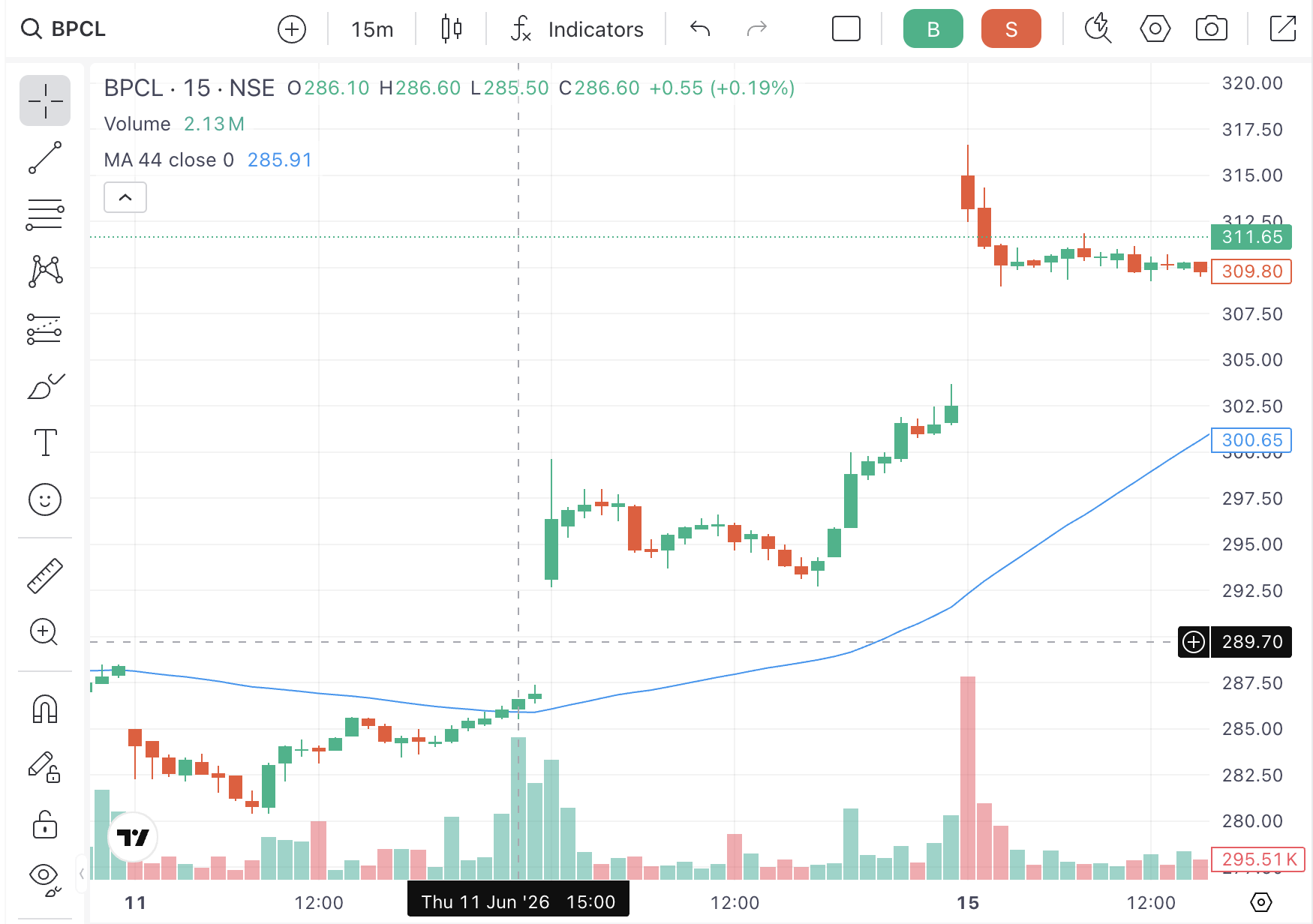
The setup forming on June 11 — both green candles sitting at the 44 SMA line, the pattern I look for before treating a move as valid.
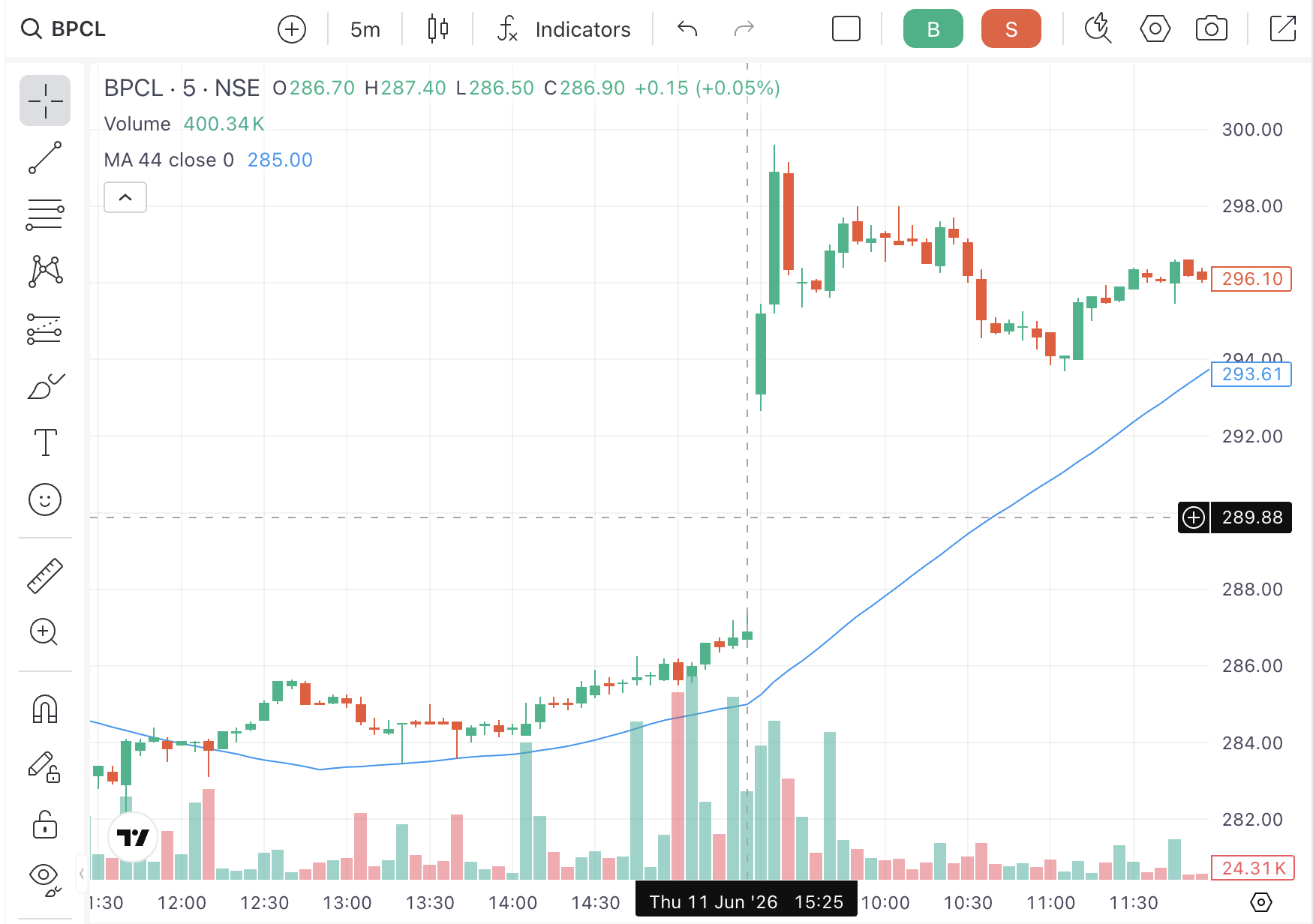
Same day, 5-minute chart — the shorter timeframe agreeing with the 15-minute trend, which is the second half of my entry checklist.
That study mattered. By the time the same structure showed up again on June 12, I wasn't reacting to a setup I'd never seen before — I was watching a pattern I already had some read on. That's the actual value of watching a stock across multiple sessions rather than treating every day as a fresh start.
The entry — and why it came after 9:30 AM
I saw the setup form, but I didn't take it the moment it appeared. The market had only just opened, and one of my own checklist rules is that I don't enter in the 9:15–9:30 AM window — that period is dominated by overnight gap reactions and opening-auction noise that has nothing to do with the actual 44 SMA signal. So I waited. Not out of nerves, just because the rule says wait, and I follow the rule.
Entry: ₹295.70, after 9:30 AM, once the setup was still valid and the candles had confirmed.
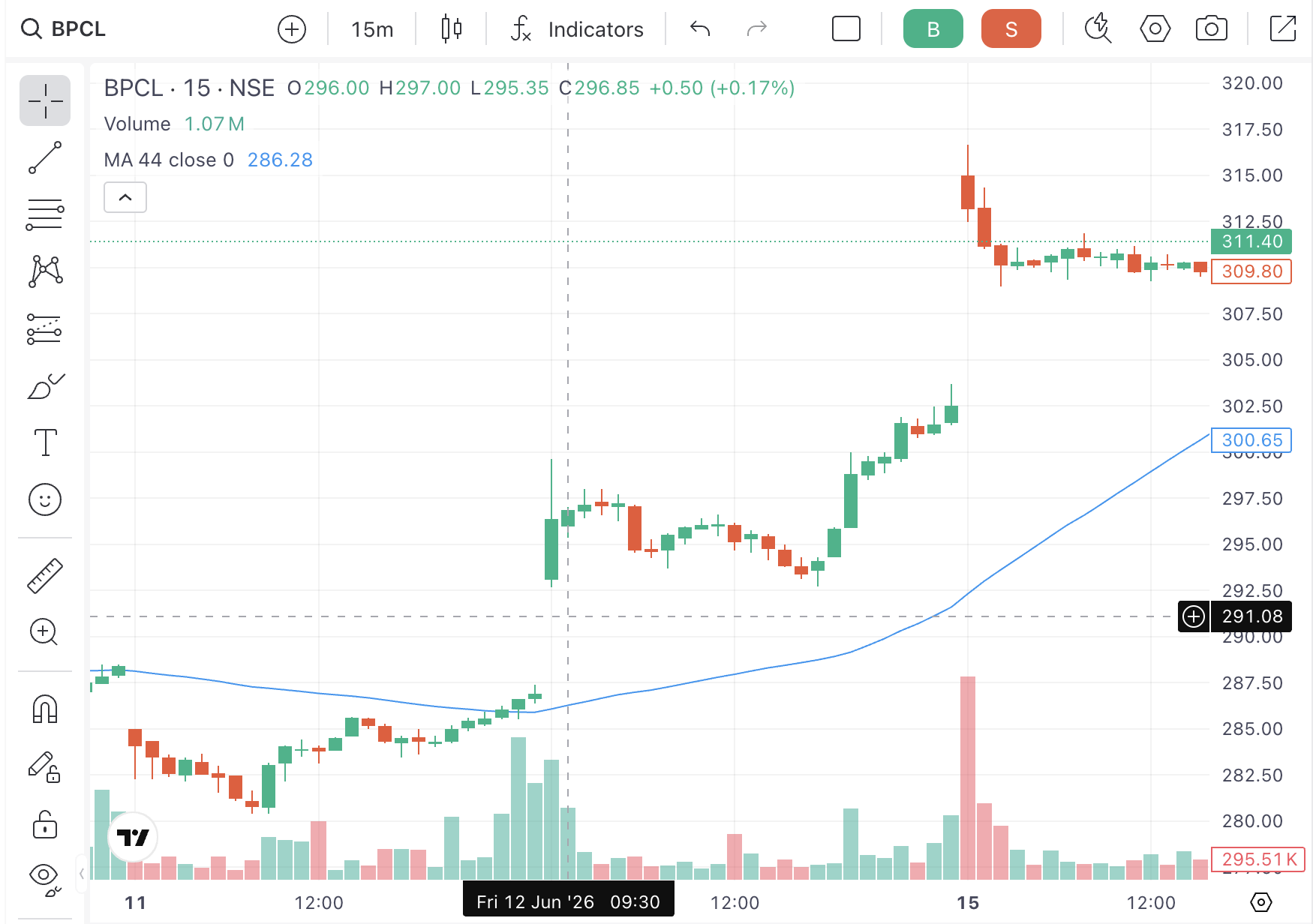
Entry zone — waiting for the clock to clear 9:15–9:30 AM before acting on the signal, even though the setup itself was already visible.
The stop loss
My stop loss rule is simple: half of the profit I expect to make on the trade, not a fixed percentage and not always the nearest swing low (though I check that too, as a sanity floor).
Target was ₹298.40, which meant an expected move of ₹2.70 per share from my entry. Half of that is ₹1.35 — so my stop loss sat at ₹294.35. If the trade had reversed, I was risking ₹1.35 to make ₹2.70: a clean 1:2 risk-reward, decided before I placed the order, not adjusted afterward.
The exit — closing in green, not chasing the last rupee
My usual exit guideline is: once price hits roughly 70–80% of the target, get out or trail the stop rather than holding for the very last bit. On this trade, I exited at ₹297.20 — around 56% of the way from entry to target, a bit earlier than that 70-80% guideline.
I'm not going to pretend that number lines up perfectly with my own rule. But the actual principle behind the rule is simpler than the percentage: the goal is closing the trade in green, not maximising every rupee available. I had a real profit on the table, after a valid setup, and I took it. Whether that happened at 56% or 75% of the theoretical target matters less than the fact that I didn't let a winning position turn into a losing one by getting greedy or distracted.
What the trade actually made — after every charge
This is the part most trading content skips, and it's the part I built a whole calculator around.
Gross profit: ₹75.00 (50 shares × ₹1.50 move)
Here's where it went:
| Charge | Amount |
|---|---|
| Brokerage | ₹29.64 |
| STT | ₹3.71 |
| Stamp duty | ₹0.44 |
| Exchange transaction charge | ₹0.88 |
| SEBI charges | ₹0.03 |
| IPFT | ₹0.03 |
| GST | ₹5.51 |
| Total charges | ₹40.25 |
Net profit: ₹34.75
Brokerage alone — ₹29.64 — ate nearly 40% of the gross profit. This is the exact problem I keep warning about on the strategy page: a small position with a small move can look profitable on the chart and still hand back a huge share of that profit in charges. On Groww specifically, the brokerage formula has a ₹5 minimum per executed order, which bites hardest on exactly this kind of small-quantity trade.
What the chart did after I exited
Here's the part that actually matters more than the charges math: BPCL kept climbing after I closed my position. Looking back at the chart from that period, price worked its way up toward ₹298–300 and eventually spiked past ₹310–315 — but not until well after 1:00 PM, roughly four hours after my entry.
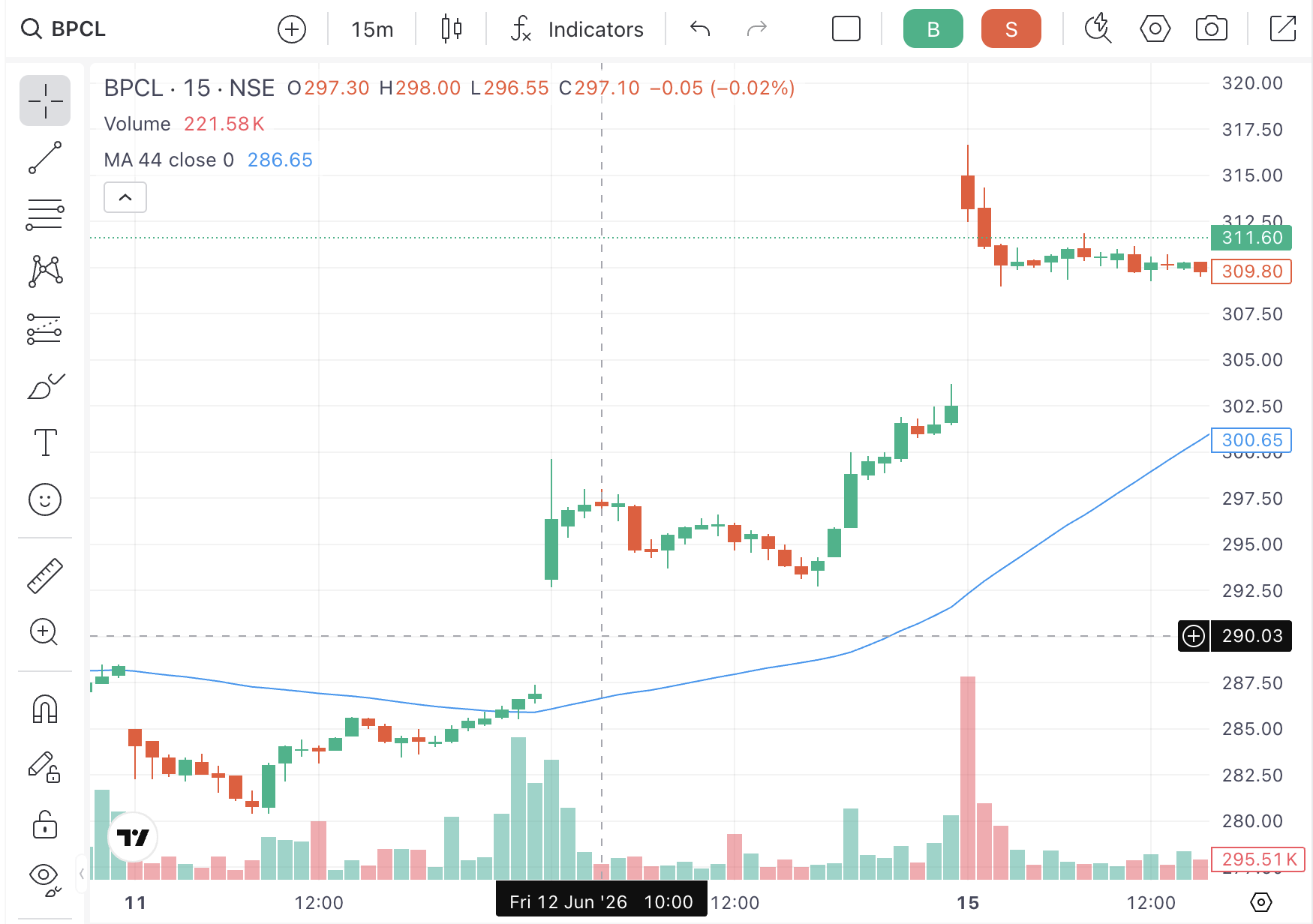
My exit, just before 9:45 AM — the bigger move toward ₹298–300+ was still hours away at this point.
If I'd stayed in the trade the whole time, I'd have made meaningfully more money. I'm not going to pretend that's not true. But I don't think "I should have waited four more hours" is the right lesson to take from this, and here's why.
Waiting from 9:30 AM to 1 PM for a single intraday position isn't good decision-making — even when the chart eventually rewards it. An intraday strategy that requires you to sit on a position for the better part of a trading day to be "right" isn't really an intraday strategy anymore. The setup gave me a real, valid signal in the morning. I took the profit it offered. The fact that the stock kept running afterward is the market doing what markets do — it doesn't mean my exit was a mistake, it means the move had more room than I needed it to have for my trade to work.
The honest lesson
Three things from this trade, in order of how much they actually matter:
The goal is closing in green, not maximising every rupee on the table. I had a real, valid signal, I took a real position, and I closed it with a profit, after charges, the same day. That's a complete, successful trade on its own terms. Comparing it to what the stock did four hours later is an interesting data point, not a verdict on whether the trade was good.
Brokerage genuinely eats small wins. ₹75 gross became ₹34.75 net — brokerage alone took nearly 40% of the gross profit. If you're trading small quantities, as I deliberately was here, run every trade through a brokerage calculator before you place it. The math can quietly turn a "profitable" trade into barely-worth-it.
Studying a setup across multiple sessions is part of the edge, not optional homework. I traded June 12 with more confidence because I'd already watched the same pattern develop on June 11. That's not something a single-day chart screenshot can teach — it comes from actually following a stock for more than one session.
This is a record of a personal trade, shared for educational purposes — not investment advice, and not a recommendation to buy or sell BPCL or any other stock. I am not a SEBI-registered advisor. Trading involves real risk of loss, and past trades, including this one, do not predict future results.