You've been using AI chatbots for a while now — ChatGPT to draft an email, Claude to explain something you didn't get in school, maybe a bot on your bank's website. Then suddenly everyone's talking about "AI agents." Same thing with a new name? A totally different piece of technology? Here's what actually changed — and whether you need to care.
Short answer first, since you don't need 2,000 words to get the gist: a chatbot answers questions. An agent completes tasks. Everything below is just filling in what that difference means in practice, where the line actually gets blurry, and which one you personally need — because for most people, the honest answer is "you don't need to think about this yet."
What a chatbot actually does
A chatbot is built for one exchange at a time. You type something, it replies, and that's the whole transaction. If you want it to do something else, you type again — the conversation history gives it context, but it isn't "continuing a task" in any real sense. It's just responding to your latest message.
This covers most of what people already use AI for every day:
- ChatGPT's free tier — you ask, it answers, inside the chat window
- The chatbot on your bank's or airline's website — routes you to an FAQ answer or hands you off to a human agent, but doesn't actually touch your account or your booking
- Basic customer support widgets — matches your question to a canned response or escalates it
Chatbots are genuinely good at a specific set of things: quick factual questions, drafting a message or an email, explaining a concept you're stuck on, summarising a long article or PDF you paste in. If the task fits entirely inside the conversation — you provide the input, it gives you an output, you use that output yourself — a chatbot is the right, fast tool.
The limitation is exactly what makes it fast: a chatbot can't do anything outside the chat window. It can't open a browser and check something live. It can't edit a file on your laptop. It can't remember what you asked it last week unless you paste that context back in (some products now offer opt-in "memory" across sessions, but even then, the model still isn't acting on your behalf between conversations — it's just recalling). Ask a plain chatbot to "book me a flight" and best case, it tells you where to look. It cannot go and do it.
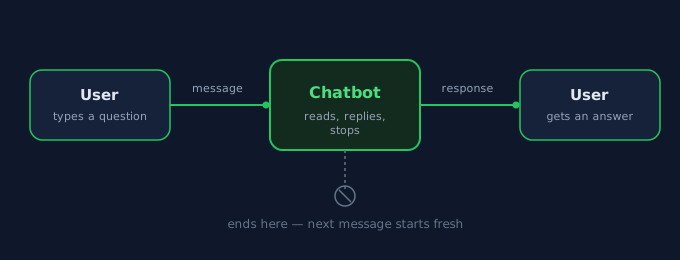
How a chatbot works — one question, one answer, done.
What an AI agent actually does
So what is an AI agent, actually? You give it a goal, not a question. It figures out the steps needed to get there, uses tools — a browser, your files, code, an API — to actually carry out those steps, checks whether the result is right, and reports back. The key word is action. An agent does things in the world (or at least in your files and browser), not just in the chat window.
A few real examples worth knowing:
- Claude Code — a coding agent that reads your actual project files, writes code, runs it, checks whether it works, and fixes it if it doesn't — repeating that loop until the task is actually done, not just described
- Perplexity — searches the live web, reads multiple sources, and synthesises an answer with citations, rather than just answering from what it already "knows"
- Computer-use agents — a newer, rougher category that can literally see a screen and click, type, and navigate through an app the way a person would
Here's the example that makes the distinction click for most people: "Book me the cheapest flight to Mumbai next Friday." A chatbot gives you instructions — which sites to check, what dates to search. An agent actually opens the sites, compares prices, and comes back with a booking (or at minimum, a completed comparison you didn't have to do step by step yourself).
That's the whole distinction in one line: chatbot = answers questions, agent = completes tasks.
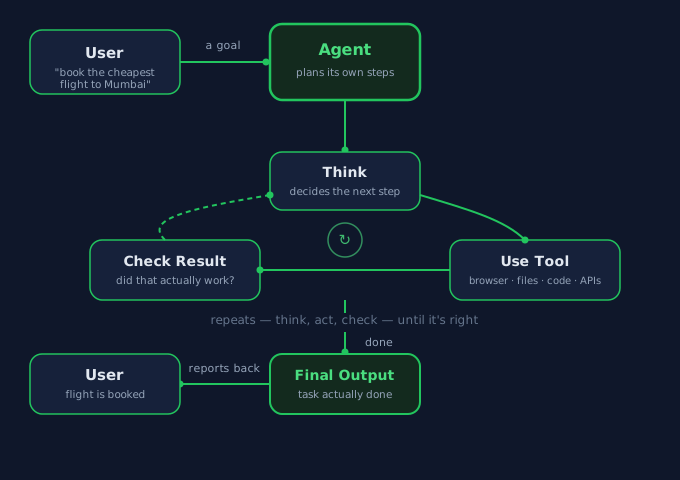
How an agent works — it loops through thinking, using a tool, and checking its own result, repeating until the goal is actually done.
The spectrum — it's not binary
Here's the part most explainers skip: the chatbot vs AI agent split isn't a clean line. Most tools in 2026 sit somewhere in between, and pretending otherwise makes you worse at judging new products, not better.
ChatGPT with plugins or its built-in tools (browsing, code execution, file uploads) is meaningfully more agent-like than the bare chat box — it's doing things outside the conversation, just in a narrower, more supervised way than something like Claude Code. Perplexity leans further toward "agent" because searching and synthesising is an active task, even though the end result still looks like a chat answer.
And here's the honest part: "AI agent" has also become a marketing term. Plenty of products slap "agent" on a feature that's really just a chatbot with a slightly longer prompt template behind it, because "agent" sounds more advanced and justifies a higher price. You'll see this a lot in 2026 — don't assume the label means anything on its own.
The real test that cuts through the marketing: can it take action outside the conversation window without you manually doing the steps yourself? If you're still the one opening tabs, copying output between apps, and clicking "send" — you're using a chatbot, however it's branded. If it opened the tab, filled the form, and only came back to tell you it's done, that's an agent.
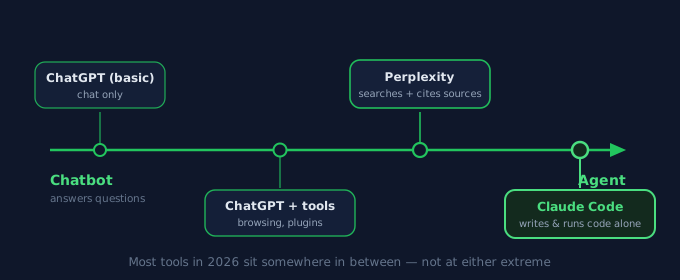
Most tools in 2026 sit somewhere between the two ends — not at either extreme.
Which one do YOU actually need
This is the part that actually matters for your day-to-day, so here's a practical breakdown by what you're trying to do — not an enterprise buying guide, just what's worth your time.
For learning, writing, and summarising
A basic chatbot is enough, and switching to something fancier won't make it faster. Explaining a concept, drafting an email, summarising a report someone sent you — these are single-exchange tasks by nature. Paying for or learning "agent" tools here is solving a problem you don't have.
For repetitive multi-step tasks
If your task looks like "research this, summarise it, format it, save it somewhere" — done over and over — agent-style tools start saving real time, because that's exactly the loop they're built for. This is where the gap between chatbot and agent starts to actually matter for your week, not just in theory.
For coding
This is the category where the agent difference is least debatable. Claude Code, Cursor, and GitHub Copilot's newer agent modes are genuinely agent-like — they read your actual codebase, make changes across multiple files, run the code, and fix what breaks. If you write any code at all, even occasionally, this is worth learning now rather than later.
For job hunting
A newer and rougher category: agents that can draft applications, tailor them to a specific job posting, and track where you've applied are starting to emerge. Worth watching, not yet worth fully trusting — verify anything that goes out under your name before it's sent, the same caution that applies to any AI-drafted document.
The honest verdict: most people don't need to think about this distinction yet. If a chatbot is doing the job — and for the majority of daily tasks, it is — there's no prize for using the more "advanced" sounding tool. Use whatever actually gets the task done with the least friction.
Tools worth knowing in each category
A short, honest list — not exhaustive, and not sponsored.
Chatbot tier
ChatGPT, Claude.ai, and Gemini — all genuinely good for daily Q&A, drafting, and explaining things. Pick based on which one you personally find easiest to have a long conversation with; the differences between them matter far less than how well you prompt any of them.
Agent tier
Claude Code for coding — currently the strongest general-purpose coding agent by independent benchmark, and the one this entire site was built with. Perplexity for research that needs live web sources and citations, not just what a model already "knows." n8n and Zapier's AI features for stitching together multi-step workflow automation without writing custom code. Devin — a fuller autonomous coding agent, but expensive and still best suited to teams, not casual individual use.
Emerging — real, but still rough in 2026
Browser agents and computer-use agents that can navigate and click through a website like a person can are real and improving fast, but still error-prone enough that you should watch them work rather than walk away and trust the result unsupervised. Worth knowing about. Not yet worth building your workflow around.
The bottom line
The chatbot vs agent distinction matters more for developers and businesses than it does for most individual users right now. But knowing the actual difference means you won't get fooled by marketing that calls everything an "agent" when it's really just a chatbot with a fancier name attached to a higher price tag.
If you're trying to figure out which specific tools are actually worth your time beyond this one distinction, the fuller breakdown — What AI Tools Are Actually Worth Learning Right Now — covers the shortlist by who you are and what you're trying to get done.
This page reflects my honest read of the chatbot-vs-agent landscape as of July 2026. The line between the two keeps shifting as chat products add more tool-use features — treat "agent" as a spectrum, not a label to take at face value.