Your first salary just hit your account. Before you spend anything — or feel guilty about spending — here's a 10-minute checklist that will actually matter 5 years from now.
Most "first salary" advice is either preachy ("save 20%, buy nothing") or so generic it's useless. This one isn't. It's written like an older friend who works in finance telling you what they wish someone had told them in their first month of earning.
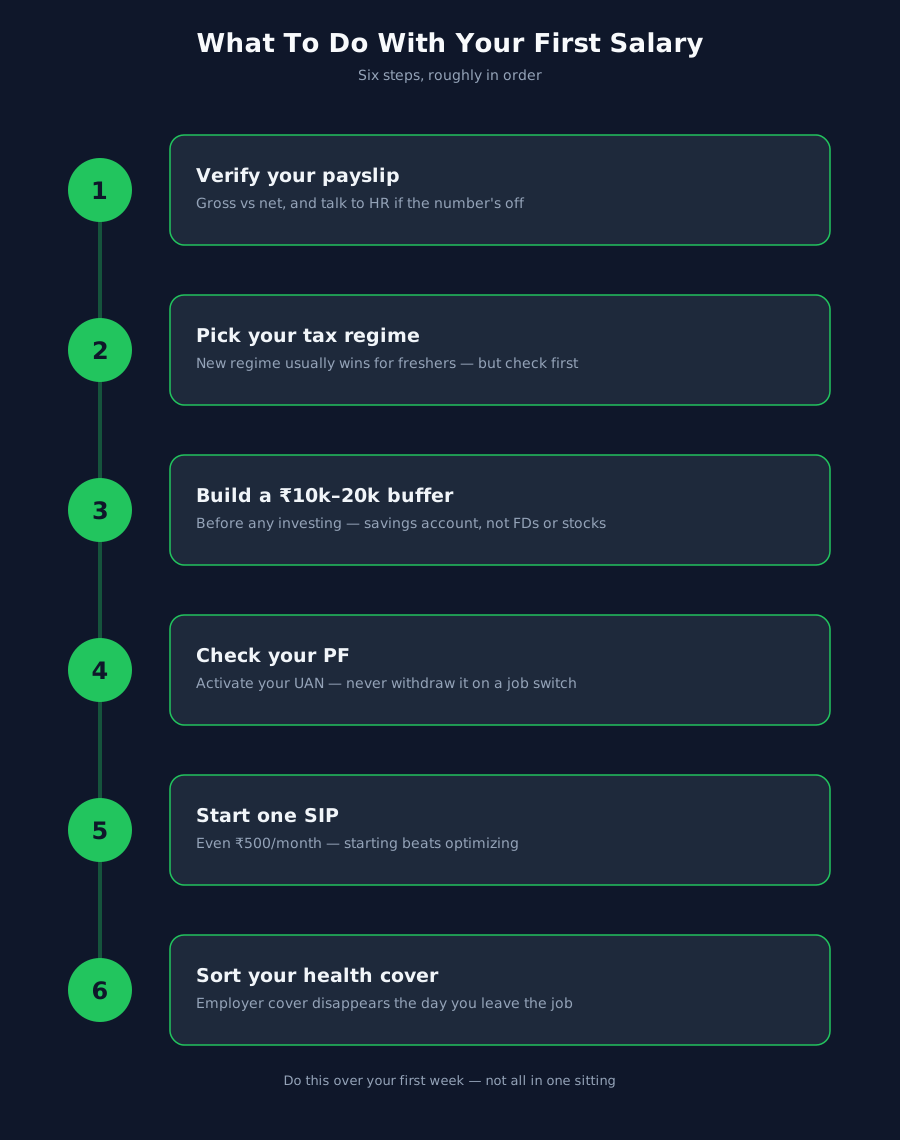
The order matters more than the amount. Do these over your first week, not all in one sitting.
First — check what actually came in
Before anything on this list, confirm the number that landed matches what you were promised. This is the step people skip the most, and it's the easiest to get wrong.
Your CTC is not your in-hand salary. The offer letter number and your bank credit will never match — employer PF contributions and TDS both get carved out before the money reaches you. That gap is normal, not a mistake.
Open your payslip and look at three numbers: gross salary, net/in-hand salary, and the deductions in between (PF, TDS, maybe professional tax). If the in-hand number looks lower than it should, don't assume payroll got it right just because it's an official document — first-month payslips are where joining-date errors, wrong tax-regime defaults, and pro-ration mistakes actually happen.
If something looks off, talk to HR directly instead of guessing.
Want to verify your in-hand figure against your CTC? Use our Salary Calculator →
Step 1 — Pick your tax regime now (don't ignore this)
Somewhere in your onboarding paperwork, your employer will ask you to declare a tax regime — new or old. This decides how much TDS gets cut from every paycheck this year, so it's not a form to click through without reading.
For most freshers — no home loan, no large 80C investments yet, no HRA claims to speak of — the new regime is almost certainly the better choice. It has lower slab rates and a flat ₹75,000 standard deduction, and if your taxable income is at or under ₹12,00,000, the Section 87A rebate can bring your tax bill to zero.
"Almost certainly" isn't "definitely," though — run your own numbers instead of guessing, especially if you're paying rent or already investing in PPF, ELSS, or insurance.
Compare both regimes with your real numbers →
One deadline worth knowing: you need to tell your employer early in the financial year. Miss it, and you default into the new regime anyway — which is fine for most people — but it's better to make it a conscious choice than an accident.
Step 2 — Build a ₹10,000–₹20,000 emergency buffer first
Before SIPs. Before stocks. Before anything with the word "invest" in it — park about one month of expenses somewhere you can reach in an hour, not three working days.
That means a savings account or a liquid fund. Not a fixed deposit (locked in, exit penalty), not stocks (can be down 15% the exact week you need the money), not crypto.
This step gets skipped constantly because it feels unglamorous — nobody brags about their emergency fund. But it's the one that actually matters: freshers who skip it are the ones who break a six-month-old SIP the first time life throws a curveball, and then don't restart it for a year.
Step 3 — Understand your PF (don't ignore it)
12% of your basic salary is already being deducted every month as your employee PF contribution. It isn't lost — it's sitting in your EPF account, earning interest, and it's entirely yours.
Your employer puts in roughly the same amount on top. That's free money you're already receiving. Here's exactly where that gap between CTC and in-hand goes →
The one mistake that costs people real money over a career: withdrawing your PF every time you switch jobs. It feels like a nice lump sum today, but you lose years of tax-free compounding. Transfer it to your new employer's PF account instead — don't cash out.
Two things to check this week: your UAN (Universal Account Number) is activated, and your PF balance is visible when you log into the EPFO portal. If you can't see it, ask HR.
Step 4 — Start one SIP, even ₹500
The amount matters less than the habit. ₹500 a month started now beats ₹5,000 a month started two years from now — the extra 24 months of compounding does more work than the extra money.
The lowest-effort place to start: a Nifty 50 or Nifty Next 50 index fund SIP. You don't need to pick between a dozen mid-cap funds or read five years of fund manager track records. An index fund just tracks the market — low cost, no fund manager risk, good enough to start with.
Don't let fund selection become the reason you don't start. Starting beats optimizing, every time, at this stage.
See how even ₹1,000/month grows over 10 years →
Step 5 — Get health insurance if your employer's isn't enough
Your employer almost certainly gives you some health cover. The catch: it's tied to your job. The day you resign, get laid off, or take a break between jobs, that cover disappears — right when you might need it most.
A basic ₹5 lakh personal health cover costs roughly ₹4,000–6,000 a year at 22-23. That's cheap insurance against a hospital bill wiping out a year of savings.
Term life insurance: skip it for now unless you have financial dependents — parents or a partner relying on your income. Most freshers don't, so this one can wait.
One honest warning: if anyone — a bank relationship manager, a cousin's insurance agent, a LinkedIn DM — tries to sell you a ULIP or endowment plan in your first few months of earning, say no. These bundle insurance and investment badly, cost more in fees than either done separately, and lock your money up for years. They are not investments. Buy insurance for insurance. Invest separately.
Step 6 — Spend on yourself without guilt (but consciously)
Every "first salary" article skips this part, and that's exactly why nobody follows the rest of the advice.
Celebrate. Buy the thing you've wanted. Take your parents out for a meal on your own money for the first time. That's the actual point of earning — not a holding pattern until you're allowed to enjoy it.
The goal isn't zero spending, it's conscious spending. A rough starting split that works for most first salaries: 50% needs, 30% wants, 20% savings/investment. It's not a rule to follow exactly — your rent might eat more than half, or you might be living with family with more room on the wants side. Treat it as a starting shape, not a cage.
What can wait (don't let anyone rush you)
A few things people will pressure you about that genuinely don't need to happen in year one:
- Real estate. Not a priority at 22. Family pressure to "buy a flat early" is common and almost always premature — ignore it.
- Stock picking. Fine to explore once your emergency fund exists and a SIP is already running. Not before.
- Crypto. Only with money you're completely fine losing — never your emergency fund or SIP money.
- NPS. A good retirement tool eventually, but not urgent in year one. Get your index SIP habit going first before adding another product to optimize.
The one-line checklist
Screenshot this if you want:
- ✅ Verified my payslip and in-hand salary
- ✅ Chose my tax regime
- ✅ Set aside ₹10,000–20,000 emergency buffer
- ✅ Activated UAN and checked PF balance
- ✅ Started one SIP (even ₹500)
- ✅ Checked if employer health cover is sufficient
- ✅ Made a conscious spending plan
Planning to get a credit card soon? Here's how your CIBIL score works → How to Improve Your CIBIL Score
This is general guidance, not personalized financial advice — your situation (dependents, debt, city, income) changes what applies to you. Numbers referenced are approximate for FY 2026-27.